
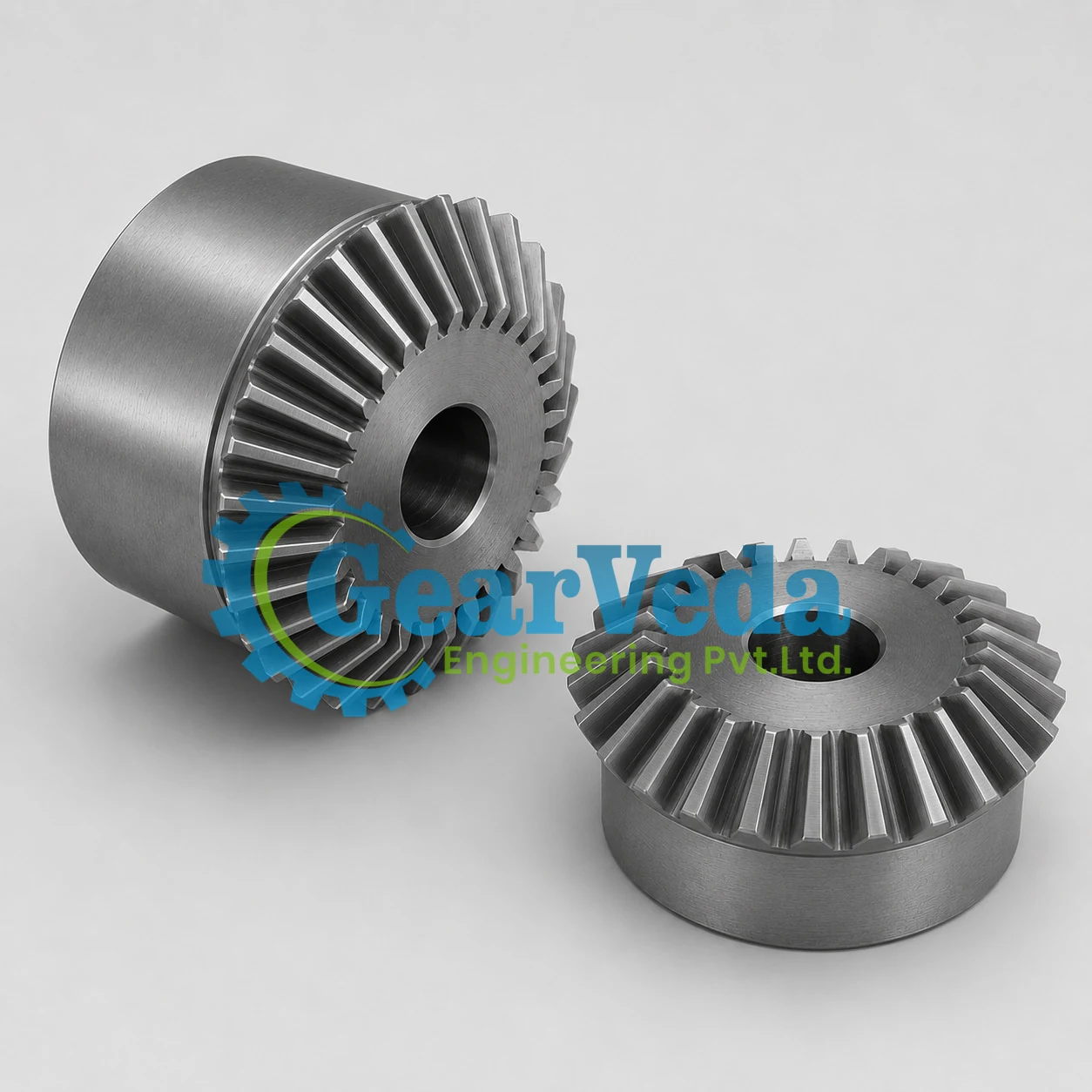
Both spiral and straight bevel gears transmit motion between intersecting shafts, but their tooth geometry changes how load enters the mesh. The right choice depends on speed, torque, noise limits, cost, accuracy and the surrounding machine design.
Key differences
| Factor | Spiral bevel gear | Straight bevel gear |
|---|---|---|
| Tooth form | Curved / spiral | Straight |
| Engagement | More gradual | More direct |
| Typical use | Higher-speed, smoother heavy-duty drives | Moderate-speed, economical drives |
| Noise & vibration objective | Generally selected for smoother operation | Suitable where simplicity is prioritized |
| Manufacturing | More specialized | Comparatively simpler |
Choose spiral bevel gears when
- Smooth, progressive tooth engagement is important
- The application has higher speed or demanding torque transmission
- Noise and vibration control matter
- A compact, durable right-angle drive is required
Choose straight bevel gears when
- The application operates at moderate speed
- Simple, dependable construction is preferred
- Cost-effective right-angle transmission is a priority
Final selection should be based on the complete duty cycle and mounting arrangement. Gearveda manufactures both custom spiral bevel gears and straight bevel gears from drawings, models or samples.