
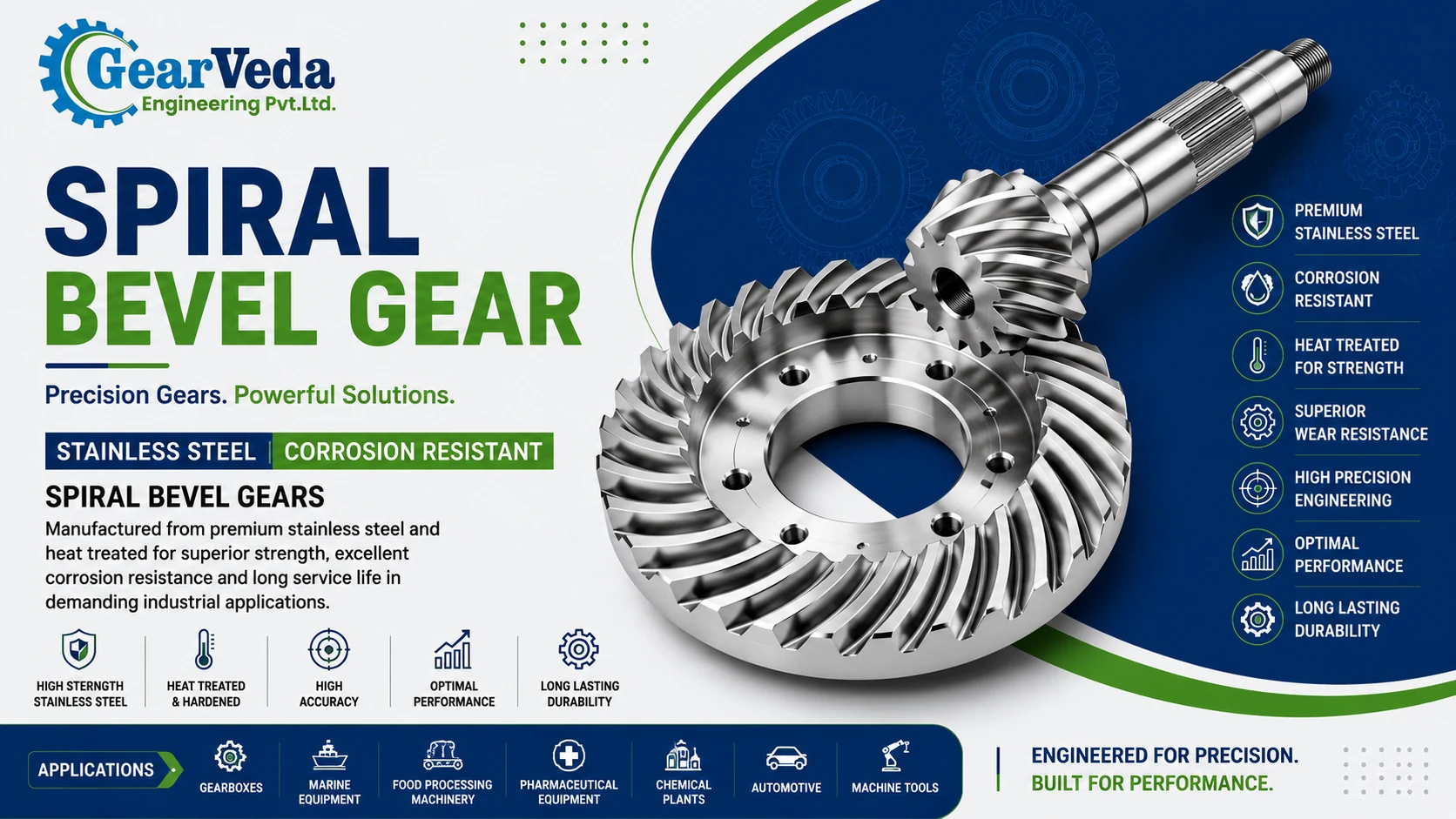
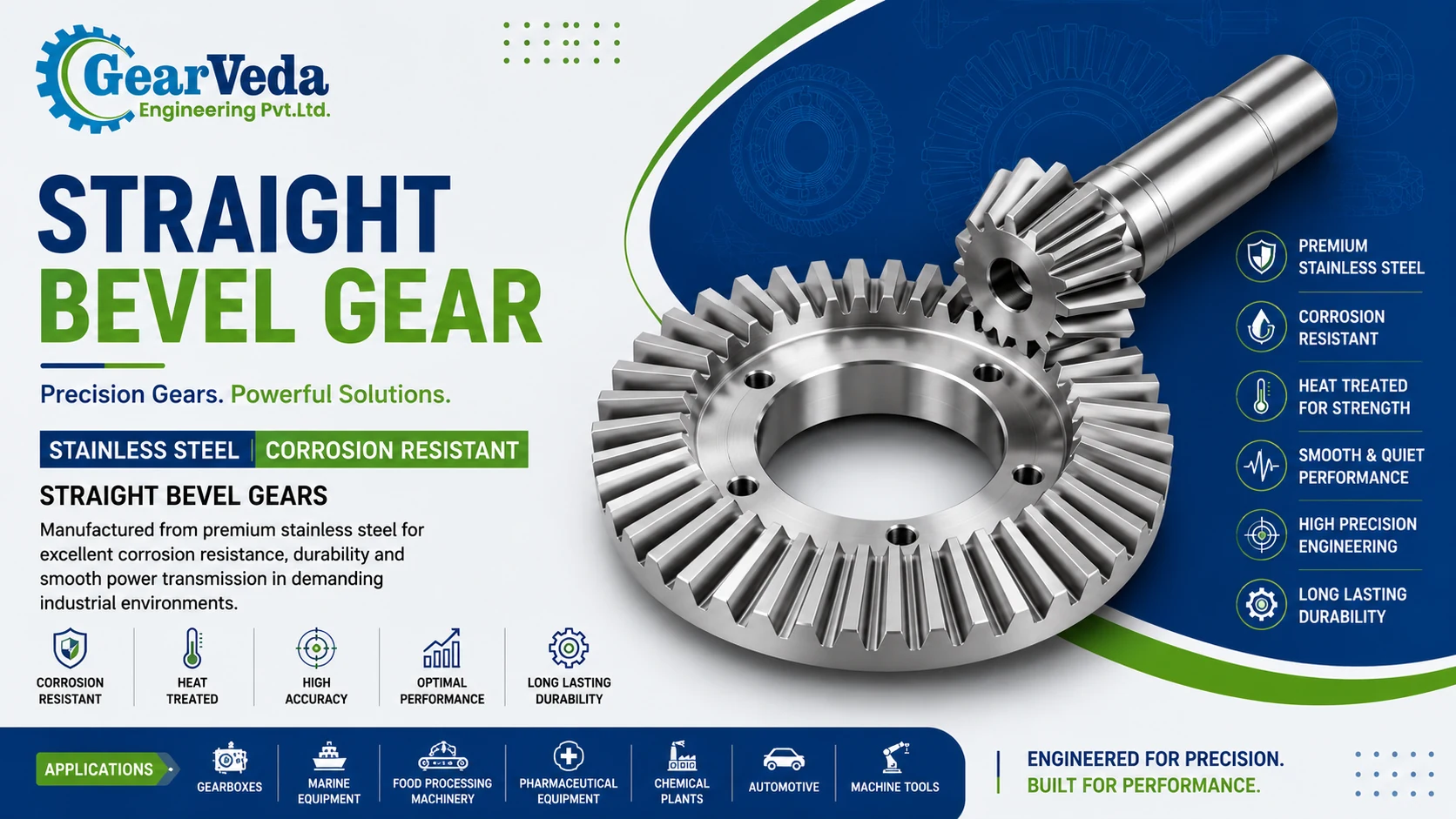
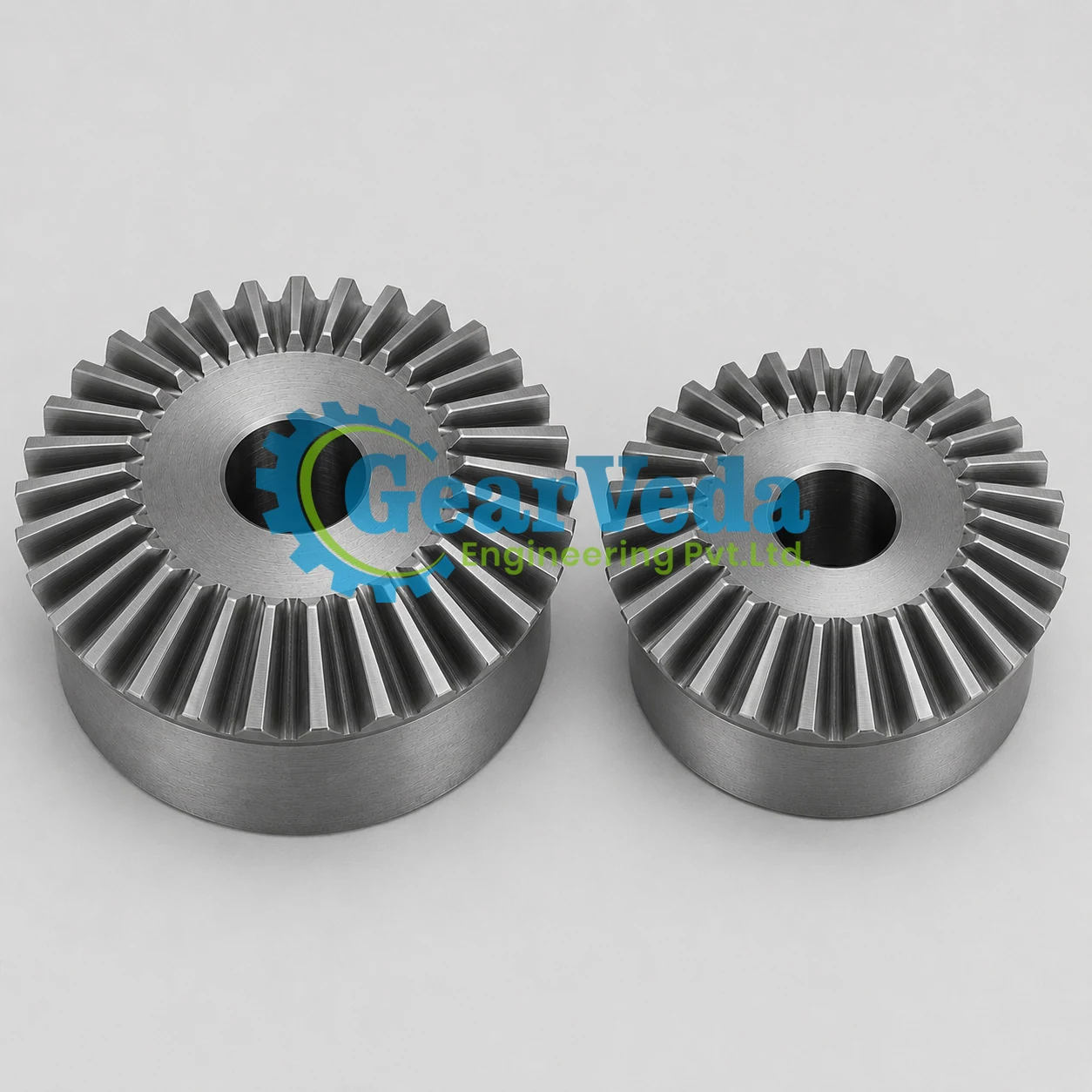
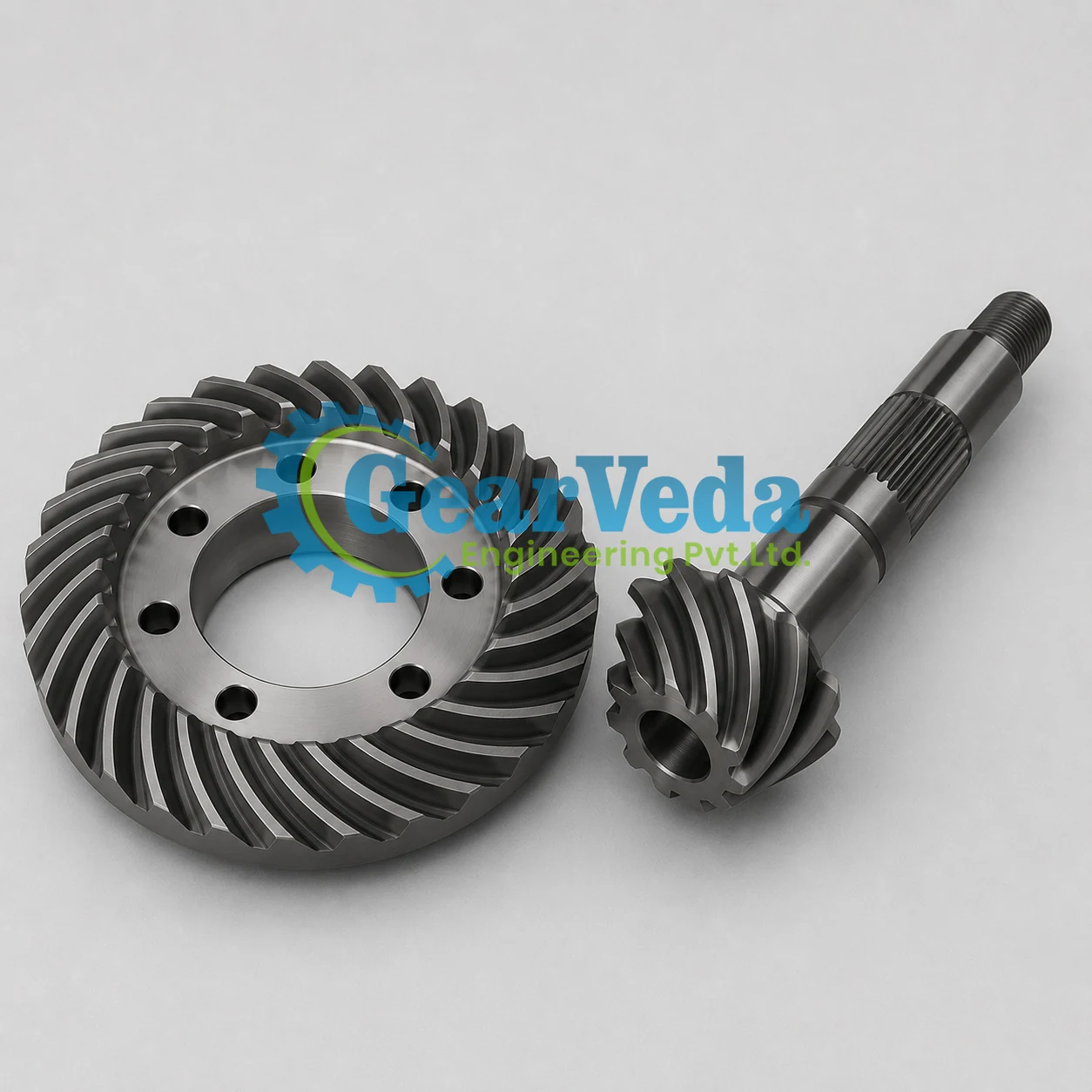
Gearveda Engineering Private Limited manufactures spiral bevel gears, bevel gears, pinions and matched gear sets for custom, OEM and replacement requirements. Engineering review can start from production drawings, CAD data, OEM references or physical samples, with the goal of establishing a manufacturable specification before machining begins.
Spiral bevel gears for right-angle power transmission
Spiral bevel gears are used to transmit motion between intersecting shafts, commonly at 90 degrees. Their curved tooth form provides progressive engagement, which can support smoother running and improved load sharing compared with a simple straight-tooth arrangement when the geometry, mounting and lubrication are correctly designed.
A spiral bevel gear should be treated as part of a mating system. Tooth counts, ratio, shaft angle, spiral hand, face width, mounting distance, backlash, accuracy and the geometry of the pinion all influence performance. For this reason, outside diameter alone is not enough to reproduce a reliable replacement component.
Manufacturing and engineering support
Gearveda supports requirements from prototype and maintenance quantities through repeat OEM batches. Depending on the component and specification, the manufacturing route may involve engineering review, blank preparation, CNC machining, gear cutting, heat-treatment coordination, finishing and dimensional inspection.
- Custom manufacture from drawings and approved CAD data
- OEM and repeat-production requirements
- Replacement components and reverse-engineering review
- Spiral bevel gear and pinion sets
- Straight bevel gears and miter gears
- Material, hardness and heat-treatment review
Materials and finishing options
Material selection depends on torque, speed, shock loading, wear, corrosion exposure, heat treatment, section size and the required service life. Common enquiry routes include alloy steel, carbon steel and stainless-steel components. Hardened or ground variants may be considered where the drawing and performance requirement justify those processes.
The appropriate route cannot be selected from a keyword alone. Buyers should provide material grade, hardness range, case-depth requirement where applicable, surface-finish expectations and any inspection standard stated by the machine or gearbox designer.
Quality information that matters
Useful quotation and inspection inputs include module or diametral pitch, tooth counts, pressure angle, shaft angle, ratio, face width, bore and keyway details, material, heat treatment, accuracy grade, backlash requirement and quantity. For replacements, photographs of the failed part and mating member help identify whether the request is a direct reproduction, a repair-driven redesign or a paired-set requirement.
OEM, replacement and reverse-engineering enquiries
For OEM projects, the preferred route is an approved drawing or CAD definition with clear tolerances and acceptance criteria. For older machinery where drawings are unavailable, Gearveda can review physical samples and available operating information. Reverse engineering is subject to the condition of the sample and the amount of mating geometry that can be established.
When only one member of a worn bevel-gear pair is available, additional data may be necessary. Manufacturing a visually similar gear without confirming the mating geometry can create poor contact, noise, heat and premature wear.
Industries and machinery applications
Bevel-gear components may be used in industrial gearboxes, differential systems, machine tools, conveyors, crushers, rolling mills, material-handling equipment, marine machinery and other right-angle drive arrangements. Actual suitability depends on the machine design rather than the industry label.
Gearveda's industry and application pages organize these requirements by operating context so engineering and procurement teams can move from a broad use case to the relevant product and RFQ information.
Send a technical requirement
For a faster response, send the drawing or sample details together with quantity, delivery location and any available operating data. The enquiry form and WhatsApp link are intended to start technical review; final manufacturability, price and delivery schedule depend on the submitted specification.