
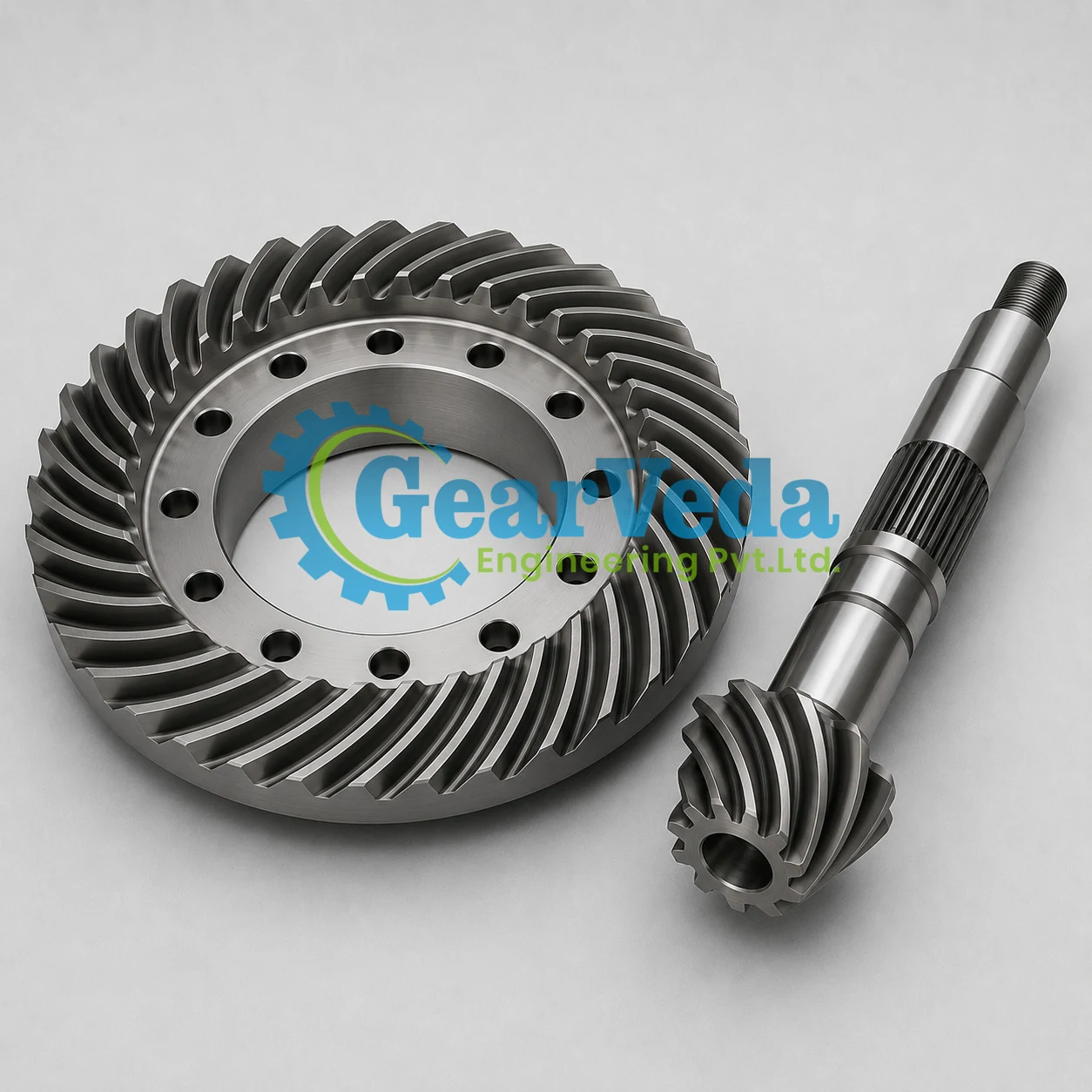
A spiral bevel gear is a conical gear with curved teeth designed to transmit rotary power between intersecting shafts, commonly at a right angle. The curved tooth form introduces engagement progressively, supporting smoother motion, lower vibration and higher load distribution than a comparable straight-tooth arrangement.
How spiral bevel gears work
A matched gear and pinion transfer torque through accurately generated tooth surfaces. Performance depends on tooth geometry, contact pattern, material, heat treatment, mounting accuracy and operating conditions. For demanding machinery, those factors should be reviewed together rather than selecting a gear only by diameter or tooth count.
Common industrial applications
- Industrial gearboxes and right-angle drives
- Conveyor and material-handling systems
- Differential systems
- Crushers and heavy machinery
- Rolling mills and steel-plant equipment
- Machine tools and automation equipment
- Marine and power-transmission systems
Why engineers select spiral teeth
Typical objectives include smoother torque transfer, reduced shock during meshing, lower operational noise, high load capacity and reliable performance at elevated speeds. Actual results depend on design, manufacture, lubrication, alignment and duty cycle.
Materials and heat treatment
Gearveda supports alloy steel, carbon steel, stainless steel, forged steel and customer-specified grades. Depending on the requirement, processes can include carburizing, case hardening, induction hardening, nitriding, through hardening and tempering.
Need a custom gear?
Share a drawing, CAD model, OEM specification or sample for reverse engineering. Our engineering team can review module, teeth, ratio, pressure angle, spiral angle, material, heat treatment and inspection requirements.